






Whale Watching Along the California Coast
- Best season for gray whales: December through mid-April, with northbound whales and calves often visible from February into spring.
- Best shore-based lookout: Point Dume, where the elevated bluff offers a wide view across Santa Monica Bay.
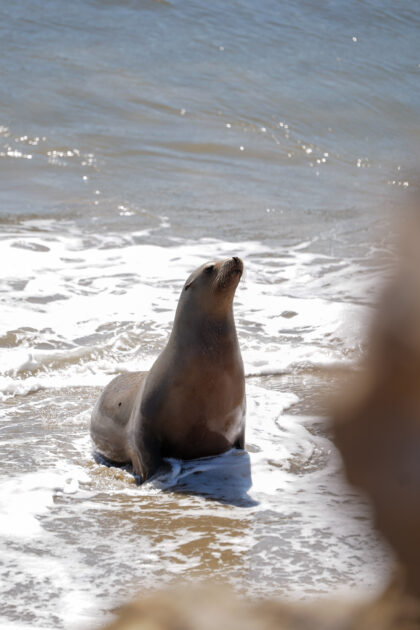
- Other possible sightings: dolphins and sea lions year-round, plus humpback, blue and fin whales outside the peak gray whale migration.
- For Malibu Beach Inn guests: keep watch from a private ocean-view balcony or Carbon Beach, then ask the concierge for help planning a Point Dume visit or boat excursion. Wildlife sightings are never guaranteed.
From the dolphins that appear among the waves to the sea turtles and schools of fish beneath the ocean’s surface, Southern California is home to an abundance of incredible sea life.
Perhaps the most impressive seasonal visitors are gray whales, which migrate past Southern California between Arctic feeding grounds and the warm lagoons of Baja California. Around Malibu, the most reliable viewing window generally runs from December through mid-April. Northbound whales, including mothers traveling with calves, may be seen closer to shore from February into spring.
“It’s thrilling,” says Rick Oefinger, President of Marina del Rey Sportfishing. “Imagine seeing some creature that is 40 or 60 feet long, and you’re within a hundred yards of them. I’ve been doing this all my life and I still get excited.”

In Malibu, whale watchers can sometimes spot whales from the comfort of their beach chairs on Westward Beach, Zuma Beach, and other shorelines between Zuma and Point Mugu. But arguably the best land view awaits on the cliffs of Point Dume, where locals and visitors can clearly look out over 180 degrees of the Pacific.
For those who wish to get up close and personal (while still keeping a respectful 100 yards away from the whales), whale watching boat excursions are offered daily from Marina del Rey and other southern harbors. Oefinger himself has been captaining whale watching expeditions, as well as sportfishing trips, five days a week for the last 40 years out of Marina del Rey.
Sometimes his crew has to search the coastline for whales, but generally the creatures can be found right in Santa Monica Bay because they come in to feed on the bay’s krill. Female whales that have just given birth to new calves are especially known for staying close to shore on the journey back to Alaska.
“Santa Monica Bay is just a wonderful place,” he says. “There is so much life here. Especially during the gray whale migration, we might see whales the second we leave the harbor. A lot of them follow the contour of the coast a few hundred yards offshore.”

Photo credit: Marina Del Rey Sport Fishing
Then, of course, there is the added bonus of spotting other sea creatures. Boat passengers can almost always expect to see dolphins and porpoises, as well as the occasional sea lion or sea turtle. Oefinger admits that children are usually more excited about the jumping dolphins, which often swim along the sides and bow of the boat, but maintains that there is simply nothing like spotting a whale.
“There’s a myriad of wonderful sea life to see on any of our cruises,” says Oefinger, “but we are primarily in search of whales. They are just incredibly magnificent creatures.”
There are obvious indications of gray whales like a spout of water expelling from a whale’s double air hole, or a breach, in which a whale leaps almost completely out of the water. But expert watermen know that a pod of whales could be nearby with just a subtle movement of the ocean. (“Most of us are fishermen at heart, and we have an eye for stuff like that,” Oefinger says.) The watermen of Santa Monica Bay keep an eye out for the whales and communicate with each other via radio to reveal exact locations.

Sightings depend on visibility, wind, sea conditions and the whales’ shifting migration routes. During the gray whale season, excursions focus on migrating gray whales; at other times of year, captains may look for humpback, blue and fin whales as well as dolphins and other marine life. Binoculars are useful from shore, while flexible timing and a little patience make for the best experience.
NOAA recommends remaining at least 100 yards from large whales. If a whale approaches a vessel, responsible captains slow down, place the engine in neutral and allow the animal to pass without chasing or encircling it. For guests staying at Malibu Beach Inn, the experience can begin on Carbon Beach or from a private ocean-view balcony, with the concierge available to help plan a visit to Point Dume or a local excursion.